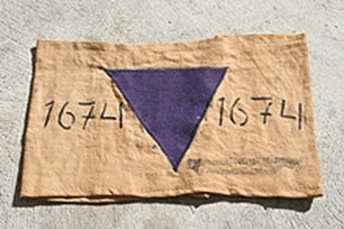
Everyday Resistance: Jehovah’s Witnesses
The commemoration in the Irish Embassy for the Irish women imprisoned in Ravensbrück Concentration camp (KZ) celebrated the 80th Anniversary of liberation. A special performance of the Berlin choir, La Voix Mixte was a reminder of the many Germans who also lost their lives or were forced to leave their homeland under Nazi persecution. Nazi polarisation into Us and Them categorised people by coloured triangles or stars which abused diversity to undermine our sense of common humanity.
In my novel Bone and Blood, Brigid, has a “guardian angel” who helps her survive in the form of Anna, a German Bibelforscherin/ Jehovah’s Witness who is also imprisoned in the camp. On her death, Anna passed her tin can for collecting the ration of turnip soup on to Brigid. Brigid finally breaks her silence about the horrors she survived, when she shares her experience with Aisling, the young Celtic Tiger Dubliner, who turns up for the funeral of Brigid’s daughter who has died of cancer. In the novel Bone and Blood, the tin can became a symbol of hope and solidarity between generations. Fiction provided a voice for ordinary people who sought unity in diversity.
“Many examples of resistance by ordinary people are not widely known or recognised,” says Hans-Georg Rennert, who worked in community development in “Sprengelkiez” in Berlin for 30 years. Widerstand 1933-1945 Wedding and Gesundbrunnen by Han-Rainer Sandvoss (Gedenkstätte Deutscher Widerstand 2002) gives an account of the many forms of German resistance against the Nazis by groups and individuals in the borough of Wedding . One example is Otto Teufert, who lived locally and was imprisoned because he spread flyers for Jehovah’s Witnesses. Hans-Rainer Sandvoss records the 25000 Jehovah’s Witnesses who lived in Germany 1933 to 1945, 10000 of them were imprisoned and 1400 lost/gave their lives. Their refusal to accept Hitler and give the Hitler salute plus their international connections were seen as a major threat. Their meetings were banned. 300 were sentenced to death for their refusal to join the army. Despite this they organised in secret and spread leaflets against the Nazi regime in secret.
Women in Ravensbrück set up exchanges between languages and cultures, which they called the “European Union”. They remind us of the mix of everyday actions and international solidarity which helped defeat fascism. Do creativity, culture and everyday resistance have a place in countering the new Reichs of to-day?
 Margo Gorman