Sister Kate McCarthy was one of the five Irish women in Ravensbrück concentration camp during World War 2. Cathi Fleming has written a biography, which puts flesh and bones onto the tall, emaciated figure of Sister Kate who returned home to Ireland after liberation of the camp. The experiences of a nun in a convent in Béthune in France; in a convent hospital in Louisiana in the United States; and her imprisonment in Germany may seem far removed from her birthplace in Drimoleague in County Cork. With a closer look, the life stories of Sister Kate and the women of many nationalities (including German) in Ravensbrück remind us how connected we all are. Yet we forget, ignore or are unaware of these connections.

Franciscan nuns at commemoration of Sister Kate in Bethune in 2024
Three of these Irish women were active in the Belgian Resistance (see blog post 31 October 2024). The Mary O’ Shaughnessy Society commemorates another Irish woman with English roots. her in England. Sister Kate will be commemorated in Ireland and Germany in 2025. Mary O’ Shaughnessy, who was born in Lancashire to Irish parents, was, like Sister Kate, active in the French resistance.
I contacted Cathi after I heard her interview about Sister Kate in 2020 with Myles Duggan (1). My novel, Bone and Blood published in 2014 explores the silence of survivors and the desire to forget the brutality humans are capable of inflicting on other humans. The account of how a “Zigeuner/Gypsy” woman was torn to bits by other women within the camp is based on survivor testimony and explores the silence of trauma. Fiction gave me the licence to reproduce research on Ravensbrück and to use imagination in the search for hope in the form of a young Dubliner, Aisling, who uncovers the story of her grand-aunt, Brigitte from County Leitrim.
The 80th anniversary of liberation is a time to honour those who remind us of our common humanity and the complexities of war. Sister Kate saved the lives of 200 British servicemen in France and sabotaged the uniforms and parachutes of German servicemen while doing forced labour. Can stories of the “ordinary” people who were in concentration camps help us today? Can we find connections to the socialists, communists, gays, lesbians, Christians, Rom, Sinti, Jews, and “others” of many skin colours and nationalities including German?
Violence, war, discrimination against the “other” are everywhere.. Resistance starts with sharing awareness of polarisation and intimidation. In the words of St Francis of Assisi who inspired Sister Kate as a Franciscan nun, “Start by doing what is necessary, then what is possible, and suddenly you are doing the impossible.” Many thanks to Catherine Fleming for her work uncovering the story of an Irish nun who did the impossible. The biography will be published in 2025.
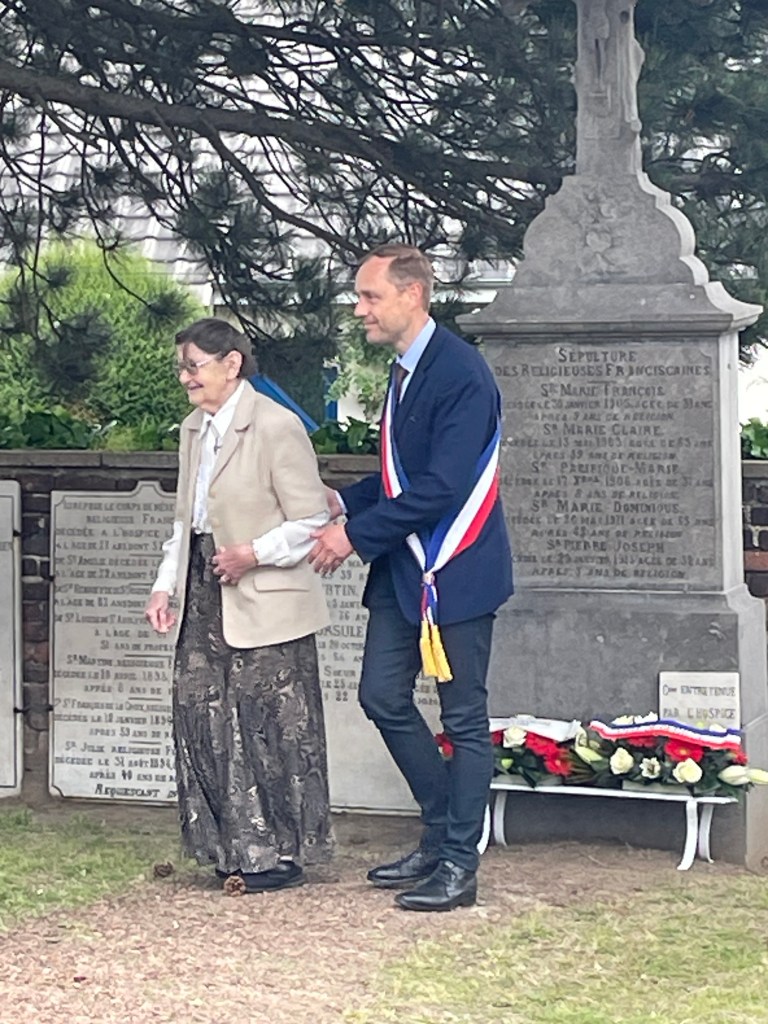
Sister Breda, niece of Sister Kate at commemoration in Bethune
(1) Myles Duggan, History Show rte.ie
 Margo Gorman