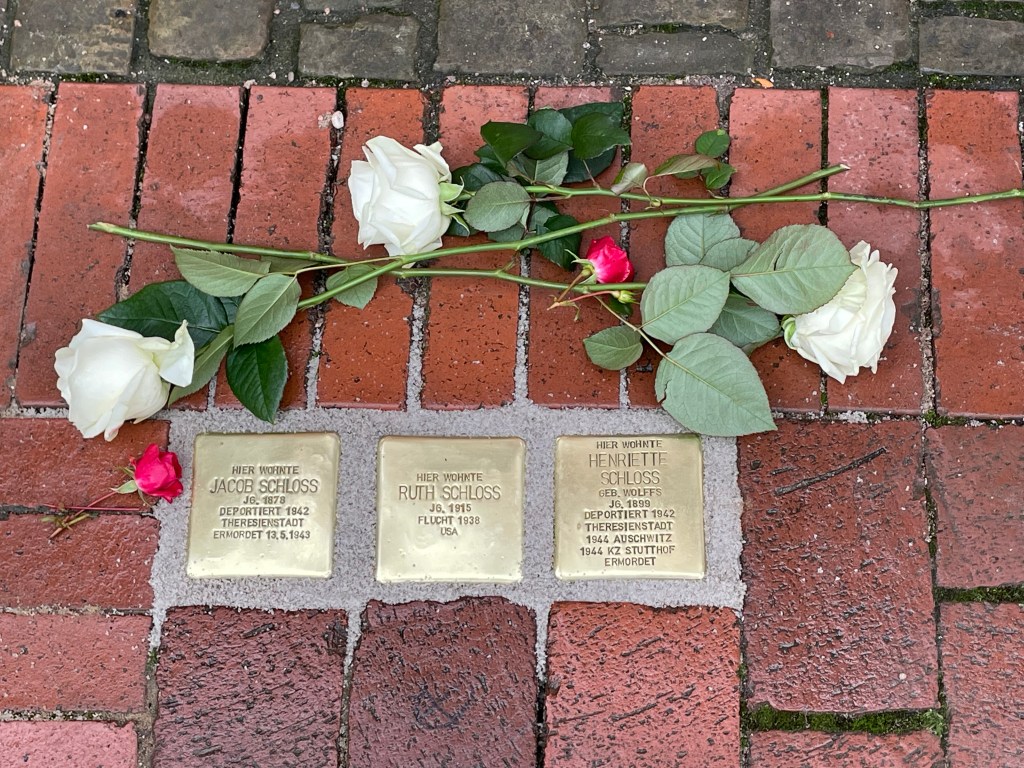
On 14th November, 2024, the first 19 Stolpersteine/stumble-stones were laid in Wunstorf. the Heimat of my partner, Schorse. Stolpersteine are small brass plaques inscribed with individual names and details of their extermination or persecution by the Nazis. Anybody who didn’t fit in was a potential target. Among those who didn’t fit in were the -Jewish people, Sinti and Romani people (known as Gypsies/Zigeuner) Homosexuals, Communists, Socialists, Christians, people with mental or physical disability, freemasons, deserters from military, Conscientious Objectors, people charged with treason, military disobedience or “anti-social” behaviour, Black people, people of many nationalities, Allied forces and those who helped them.
First they came for the socialists, and I did not speak out
- because I was not a socialist.
Then they came for the trade unionists, and I did not speak out
- because I was not a trade unionist.
Then they came for the Jews and I did not speak out
- because I was not a Jew.
Then they came for me and there was no-one left to speak out for me.
Pastor Martin Niemöller
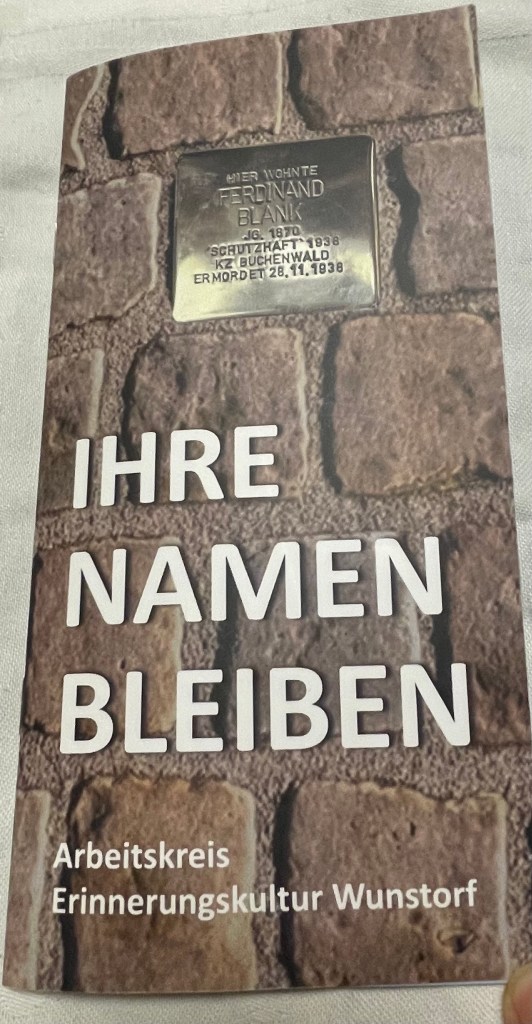
Schorse Rernnert shares his imprssions in German with an English Translation below:
Ihre Namen bleiben. Stolpersteine in Wunstorf verlegt
Am 14. November 2024 wurden die ersten 19 Stolpersteine in meiner Heimatstadt Wunstorf verlegt. Damit hat der Arbeitskreis Erinnerungskultur Wunstorf einen wichtigen Zwischenschritt erreicht. Dieser Kreis engagierter Wunstorfer:innen hat sich zum Ziel gesetzt, allen von den Nazis ermordeten Wunstorfern individuelle Denkmale zu setzen. Die Stolpersteine des Künstlers Gunter Demnig sehen sie als die am besten geeignete Form dafür.
„Der Künstler Gunter Demnig erinnert an die Opfer der NS-Zeit, indem er vor ihrem letzten selbstgewählten Wohnort Gedenktafeln aus Messing ins Trottoir einlässt. Inzwischen liegen STOLPERSTEINE in 1265 Kommunen Deutschlands und in einundzwanzig Ländern Europas. ‘Ein Mensch ist erst vergessen, wenn sein Name vergessen ist’, zitiert Gunter Demnig den Talmud.“ (https://www.stolpersteine.eu/start – Zugriff 18.11.24)
Die Stolpersteine erinnern an 19 Menschen, die hier lebten und aufgrund ihres jüdischen Glaubens erniedrigt, entrechtet, beraubt, ermordet wurden. Nun kann es passieren, dass man auf dem Schlendern durch die Fußgängerzone über die Erinnerungen an diese ehemaligen Nachbarn „stolpert“ und zum Nachdenken angeregt wird. Über die Vergangenheit, die heutige Situation und das mögliche eigene Verhalten.
Eine wichtige Grundlage für die Recherchen des Arbeitskreises bildet das Buch „Das Schicksal der Juden in Wunstorf“ von Heiner Wittrock, 2. Auflage Wunstorf 2007. Mich hat die Lektüre dieser akribischen Arbeit beeindruckt und erschüttert. Für acht aus Wunstorf stammende Juden wurde Auschwitz zur letzten Station ihres Leidensweges. Aus der Langen Straße auf die Todesrampe: das gab es auch in Wunstorf und das darf es niemals wieder geben!
Was können wir dafür tun?
Die Stolpersteine erinnern an: Hans Bensew, Hugo Bensew, Kurt Bensew, Martha Bensow, Werner Bensew, Ferdinand Blank, Renate Salinger, Bernhard Kreuzer, Else Kreuzer, Hans-Joachim Kreuzer, Klaus Kreuzer, Albert Mendel, Henry Mendel, Rosa Mendel, Willi Mendel, Flora Roth, Henriette Schloss, Jacob Schloss, Ruth Schloss
Wer mehr über diese 19 Menschen wissen möchte, kann die Broschüre „Ihre Namen bleiben“ des Arbeitskreis Erinnerungskultur Wunstorf lesen, die hier zu finden ist: https://www.wunstorf.de/portal/seiten/wunstorfer-stolpersteine-922001543-20550.html
Their names remain. Stolpersteine laid in Wunstorf
On November 14, 2024, the first 19 Stolpersteine/stumbling blocks were laid in my hometown, Wunstorf. The Wunstorf Working Group for the Culture of Remembrance has achieved an important milestone. This group of committed Wunstorf residents has set itself the goal of placing individual memorials to all Wunstorf residents murdered by the Nazis. They see the stumbling blocks by artist Gunter Demnig as the most suitable form for this.
“The artist Gunter Demnig commemorates the victims of the Nazi era by placing brass memorial plaques on the pavement in front of their last chosen place of residence. There are now STOLPERSTEINE in 1265 municipalities in Germany and in twenty-one European countries. ‘A person is only forgotten when his name is forgotten’, Gunter Demnig quotes the Talmud.” (https://www.stolpersteine.eu/start – accessed 18.11.24)
The Stolpersteine in Wunstorf commemorate 19 people who lived here and were humiliated, stripped of their rights, robbed and murdered because of their Jewish faith. While strolling through the pedestrian zone, you may stumble across the memories of these former neighbours and be prompted to reflect. About the past, the current situation and how you would have behaved.
The book “The Fate of the Jews in Wunstorf” by Heiner Wittrock, 2nd edition Wunstorf 2007, forms an important basis for the working group’s research. Reading this meticulous work impressed and shocked me. For eight Jews from Wunstorf, Auschwitz was the last stop on their path of suffering. From Lange Straße to the death ramp: that also happened in Wunstorf and it must never happen again!
What can we do about it now?
 Margo Gorman
Thank you xx
A great entry in this interesting blog by Margo Gorman. Thank you. Greetings from Wunstorf and Berlin to Donegal!