80 years ago three ordinary Irish women were still imprisoned in Ravensbrück Concentration Camp for their role in the Belgian Resistance. 80 years ago HOPE for their liberation marched through Belgium.
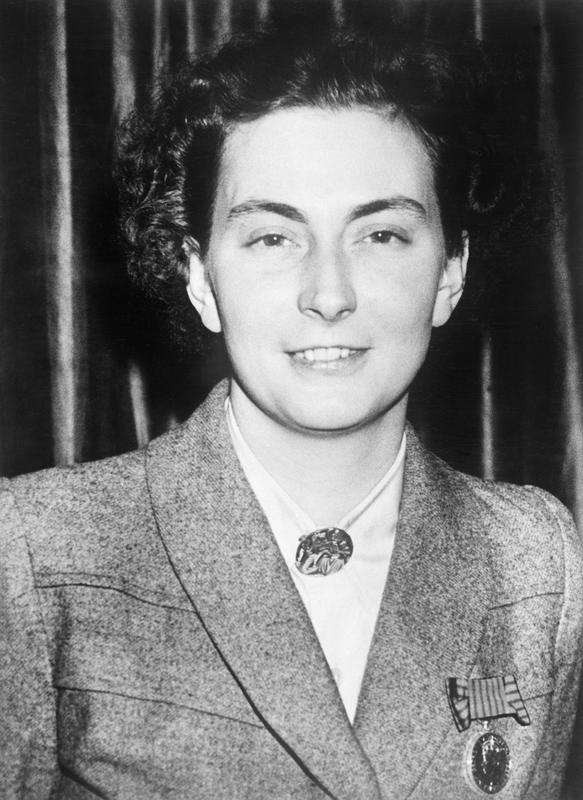
The photo of Andrée de Jongh (wikipedia), who organised and led the Comet Line to “assist Allied soldiers and airmen to escape from Nazi-occupied Belgium”, was taken after she received the George Medal in Buckingham Palace, London, in 1946. Stories of Irish women Mary Cummins, Catherine Crean and Agnes Flanagan who like Andrée de Jongh were arrested in occupied Belgium and imprisoned in Ravensbrück Concentration Camp show how the actions of ordinary civilians helped undermine fascism with its racist, anti-semitic, anti-communist, anti-christian, anti-gay, anti-human ideology.
In 2005. a bike tour with my German partner, led me to the site of Ravensbrück Concentration Camp on the edge of Fürstenberg in former East Germany. Horror hit my solar plexus as one recording of a survivor told the story of a “Zigeuner/Gypsy” woman who had escaped into the woods near the camp. For several days the other prisoners in her block were punished – no rations of turnip soup or bread, standing for hours in the cold, on top of the usual daily round of heavy work, hunger, harassment, abuse and the threat of death. When the runaway was found and returned to the block as a beaten heap of humanity, the other prisoners in the block tore her to pieces. How could THEY do it? How do WE do it?
Sectarianism in my homeplace, Ulster with its polarisation and manipulation of Irish versus British identity plus years of working on children’s rights with Rom, Irish Travellers and many other ethnicities in England taught me to look more closely at US, THEM and the OTHER and how our common humanity is undermined. We can all be complicit with the polarisation of meglomaniacs, oligarchs and moguls, wittingly or unwittingly. How can we replace this complicity with commitment to our shared humanity?
Learning that five Irish women had been imprisoned in Ravensbrück inspired me. As there was limited information on them available at the time, I decided to create a fictional Irish woman, Bridget, in my novel Bone and Blood, to explore survivor silence and seek hope for future generations. Research by John Morgan of Escape Lines has brought more information on these Irish women. Catherine Crean was active in Luc, another Belgian resistance network and died of dysentery just weeks before the liberation. Mary Cummins told of her role “translating, passing messages, informing and smuggling arms – resulted in her being arrested at gunpoint by the Gestapo who walked into her Brussels apartment early one morning as she slept. Her landlady had given them the key”. She was interviewed on Irish radio when she was in her eighties and back living in Ireland. Agnes Margaret Flanagan testified in French to the UK Foreign Officein 1965 that she tended injured English soldiers; helped an English prisoner escape; and destroyed documents with information on the Belgian resistance. She was a nun but left the convent after the war and took on Belgian nationality when she married Emil Depret.
Humans are capable of the worst but also of the best. These ordinary women under the banner of Fight without weapons used laughter to console the injured, flirted with German soldiers to conceal documents, and organised escape routes. They sought out humane connection against the odds. We CAN fight polarisation without weapons. We CAN support those like Standing Together in Israel www.standing-together.org and all those who join together in solidarity against meglomaniacs.
Margo Gorman Bone and Blood, a Berlin novel ISBN 978-1-78462-037-001099 http://www.books.ie
 Margo Gorman